Bitcoin price nears $84K as ETF inflows reach five days

Bitcoin has traded near $84,000 on Sept. 24 after rejecting the $87,000 area, while 100–1,000 BTC wallets accumulated 113,950 BTC and U.S. spot Bitcoin ETFs extended their net inflow streak to five sessions.
- Bitcoin traded near $84,000 after retreating from $87,000 and meeting resistance around the $86,700 level.
- Wallets holding 100–1,000 BTC added 113,950 BTC since July 15, reaching roughly 5.24 million BTC.
- U.S. spot Bitcoin ETFs drew $346.98 million September 23, extending net inflows to five sessions.
- Binance Bitcoin open interest fell $500 million as leveraged traders reduced exposure after $87,000 push.
- Bitfinex placed a key buyer cost range between $85,000 and $86,500 after Bitcoin’s latest rally.
CoinGecko data showed Bitcoin at $83,863.54 during the latest check, down 3.8% over 24 hours but up 9.9% over seven days. Trading volume stood near $42.69 billion, while the asset’s market capitalization was approximately $1.685 trillion.
The pullback followed a run to $87,392 on Sept. 21, the highest print since Jan. 29, according to Bitfinex Alpha. In related crypto.news coverage of Bitcoin’s $83,600 Supertrend support test, BTC had already lost momentum after moving above $87,000 and falling back below $85,000.
Bitcoin price stays above Rekt Capital’s $82K support zone
Crypto analyst Rekt Capital said Bitcoin was meeting resistance around $86,700 after its breakout from the previous $60,000–$80,000 range. In a Sept. 23 post, the analyst described the resistance as “nothing too convincing for the time being,” while keeping attention on support below the market.
#BTC
— Rekt Capital (@rektcapital) September 23, 2026
Bitcoin is finding resistance at ~$86700 but nothing too convincing for the time being
For bullish continuation and to avoid reverting back into the $60k-$80k Range, Bitcoin would need to stay above or at minimum successfully retest ~$82k on any future dip$BTC #Bitcoin https://t.co/V7yazqhbsM pic.twitter.com/eaKkY15FFI
Rekt Capital said Bitcoin would need to remain above roughly $82,000, or successfully retest the area during a future dip, to stay positioned for bullish continuation. A later post placed the previous range high around $80,000 and said Bitcoin had not fully confirmed its breakout until that area had been tested as support. Both levels represent the analyst’s technical framework, not guaranteed price outcomes.
Meanwhile, on the one-hour chart, Bitcoin’s RSI stood at 39.38 while the Money Flow Index was 37.71. Both indicators remained below 50 after the pullback from the $86,000–$87,000 area, pointing to weaker short-term momentum without entering deeply oversold territory.
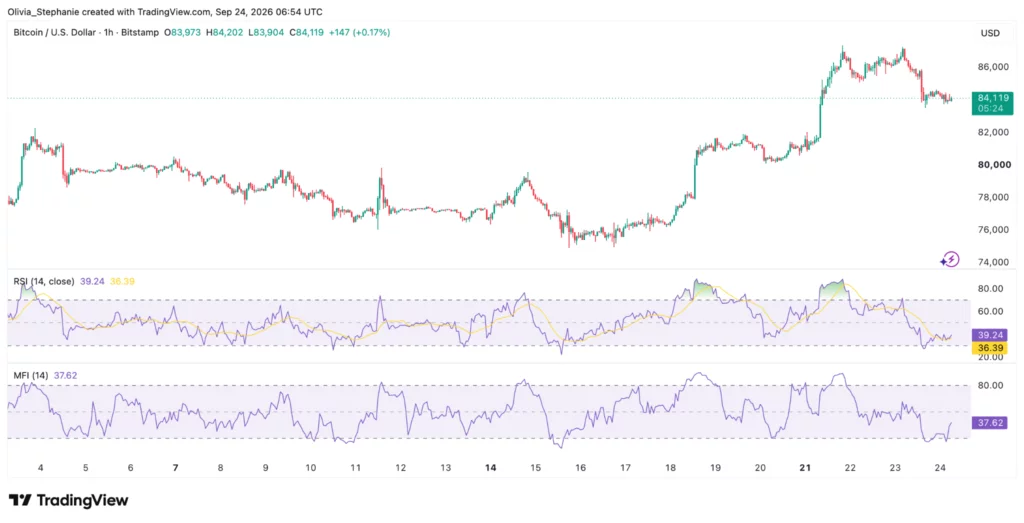
A separate crypto.news market analysis placed four-hour Supertrend support near $83,593 after Bitcoin fell from roughly $87,279.
Bitfinex Alpha described $85,000–$86,500 as a high-volume buyer cost area after the move to $87,392. Its Sept. 23 report said Bitcoin had reached a price area that separated lasting recoveries from failed rebounds during previous cycles, while continued ETF and corporate purchases remained part of its framework.
Bitcoin whales have added 113,950 BTC since July
Santiment posted that wallets holding between 100 and 1,000 BTC increased their combined balance by 113,950 BTC from July 15 through Sept. 23. The cohort’s holdings rose 2.22% to approximately 5.24 million BTC during the period. Independent reports citing the same Santiment dataset carried matching figures.
🐳 Bitcoin’s 100-1,000 $BTC wallets are accumulating fast. Since July 15, they’ve added 113,950 BTC, growing their collective holdings by 2.22% to roughly 5.24M BTC.
— Santiment Intelligence (@SantimentData) September 23, 2026
🧠 This wallet tier has historically been one of Bitcoin’s most useful smart money groups to watch. Santiment’s… pic.twitter.com/tCntKfdPQg
Santiment described the group as one of the wallet tiers that has tracked crypto market direction closely in its five-year analysis. The firm said accumulation by the cohort has often appeared before or during stronger price periods. Historical correlation, however, does not establish that changes in the group’s balances caused Bitcoin’s subsequent price moves.
Wallet data carries another limitation. An address does not represent a confirmed individual investor because one entity can control several wallets, while exchanges and custodians can move coins among addresses. The figures therefore document rising balances inside the 100–1,000 BTC cohort without proving that a known group of institutions or funds purchased the coins on the open market.
During the same period, Bitcoin recovered sharply from its July 1 low of $57,803, according to Bitfinex. The price reached $87,392 on Sept. 21 before retreating toward $84,000 this week.
U.S. Bitcoin ETF inflows have reached five straight sessions
SoSoValue-linked data reported $346.98 million in net inflows for U.S. spot Bitcoin ETFs on Sept. 23. BlackRock’s IBIT led with $166.29 million, followed by Fidelity’s FBTC at $143.24 million. Morgan Stanley’s MSBT received $32.41 million, while ARK 21Shares’ ARKB took in $5.04 million.
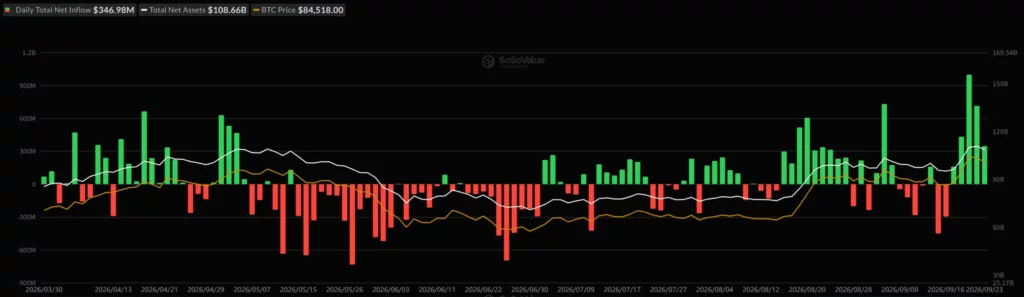
The Sept. 23 total extended the positive run to five trading sessions. The streak included $159.5 million on Sept. 17, $433 million on Sept. 18, approximately $999 million on Sept. 21 and $714.7 million on Sept. 22 before the latest $346.98 million reading. The five sessions brought combined net inflows to roughly $2.65 billion. Earlier crypto.news coverage examined Bitcoin ETF inflows during the move above $86,000.
Demand during the session extended beyond Bitcoin products. SoSoValue data showed U.S. spot Ether ETFs receiving $105 million on Sept. 23, led by BlackRock’s ETHA with $50.8 million and Fidelity’s FETH with $41.3 million. Grayscale’s ETH fund recorded approximately $4.1 million in net outflows.
Binance leverage has fallen faster than Bitcoin’s price
CryptoQuant analyst Amr Taha said Binance Bitcoin open interest fell from roughly $5.4 billion to $4.9 billion between Sept. 21 and Sept. 23. The $500 million reduction removed approximately 9.3% of outstanding positions while Bitcoin pulled back around 3.4% from the $87,000 area.
Taha reported that cumulative volume delta fell from nearly $3 billion to $1.48 billion over the same period, a decline of roughly 51%. He interpreted the combination of lower price, open interest and CVD as evidence that leveraged traders had reduced risk after Bitcoin failed to hold the push toward $87,000. The interpretation does not identify the individual traders behind the positions.
A separate CryptoQuant update dated Sept. 23 showed Binance BTC funding near 0.001%, close to neutral. Its author said funding around zero indicates that derivatives positioning has become less one-sided than during periods of aggressive leveraged-long activity.
Bitfinex, in its Bitcoin $85K buyer cost analysis, placed the next major cost area between $85,000 and $86,500, with the yearly open at $87,722 above it. The firm put the corporate treasury cohort’s average cost near $80,500 and said “a sustained move below $81,300,” particularly alongside ETF outflows, would challenge its reading of the breakout.